
Most ghee on the market is made in minutes. Cream gets separated by machine, heated fast, and packed the same day. A2 Bilona ghee does not work that way. It takes days of hand churning before it ever touches a flame, and that extra time is exactly why brands like SRC Farms still make it the old way instead of the fast one.
If you have ever compared two jars of ghee side by side and noticed one has a coarser, more granular texture while the other is smooth and almost buttery soft, you have already seen the Bilona process at work without knowing its name. This post walks through what the Bilona method actually involves, why the milk source matters just as much as the process, and what that means for the ghee you end up cooking with.
What Is A2 Bilona Ghee?
A2 Bilona ghee is ghee made from A2 milk using the Bilona method, a technique that has been used in Indian households for generations, long before commercial dairies existed. Instead of separating cream directly from milk, the milk is first set into curd overnight. That curd is then hand churned with a wooden Bilona, a traditional wooden churner, to extract butter. The butter is washed, then slowly cooked into ghee over a low flame.

This is different from Bilona desi ghee made with A1 or mixed milk in one specific way: the milk itself comes from indigenous cow breeds that naturally produce the A2 beta casein protein instead of A1. Breeds like Gir and Sahiwal are commonly used for this reason. The churning and cooking process stays the same either way, but the starting milk changes what ends up in the jar.
Why Does the Bilona Process Make A2 Ghee Different?
The real difference shows up before the ghee is even cooked. Commercial ghee production usually starts with cream, pulled straight from milk using a centrifuge, then heated directly and packaged the same day. It is fast, consistent, and easy to scale, but it skips the fermentation step almost entirely.
Bilona ghee starts with curd instead of cream. That curd gets churned by hand, which pulls butter out slowly and unevenly compared to a machine. That unevenness is not a flaw, it is actually part of what builds the texture and grain associated with real A2 milk ghee. The butter then goes onto a low flame, often cooking for far longer than a commercial batch ever would.
The result is ghee with a coarser grain, a deeper golden colour, and a stronger, more distinct aroma than machine made versions. None of that happens by accident. It comes directly from the steps most large scale producers cut out to save time and cost.
How Is Bilona Ghee Traditionally Made? Step by Step
The traditional process of making Bilona cow ghee generally follows five stages, and skipping any one of them changes the final product.
- Milk to curd: Fresh milk is set into curd using a natural culture, usually left to ferment overnight.
- Hand churning: The curd is churned by hand using a wooden Bilona, separating butter, known as makhan, from the buttermilk.
- Butter collection: The butter is collected and rinsed to remove leftover buttermilk before cooking.
- Slow cooking: The butter is heated on a low flame until the milk solids separate and settle at the bottom, leaving behind clarified golden liquid on top.
- Cooling and straining: The ghee is cooled and strained to remove the last of the milk solids, leaving pure A2 bilona cow ghee behind.
Each stage depends on the one before it. Cook on high heat to save time, use a mechanical separator instead of hand churning, or skip the curd stage entirely, and what you get is regular ghee, not true Bilona ghee. The label only means something if every step behind it actually happened.
Bilona Ghee vs. Machine-Made Ghee: Quick Comparison
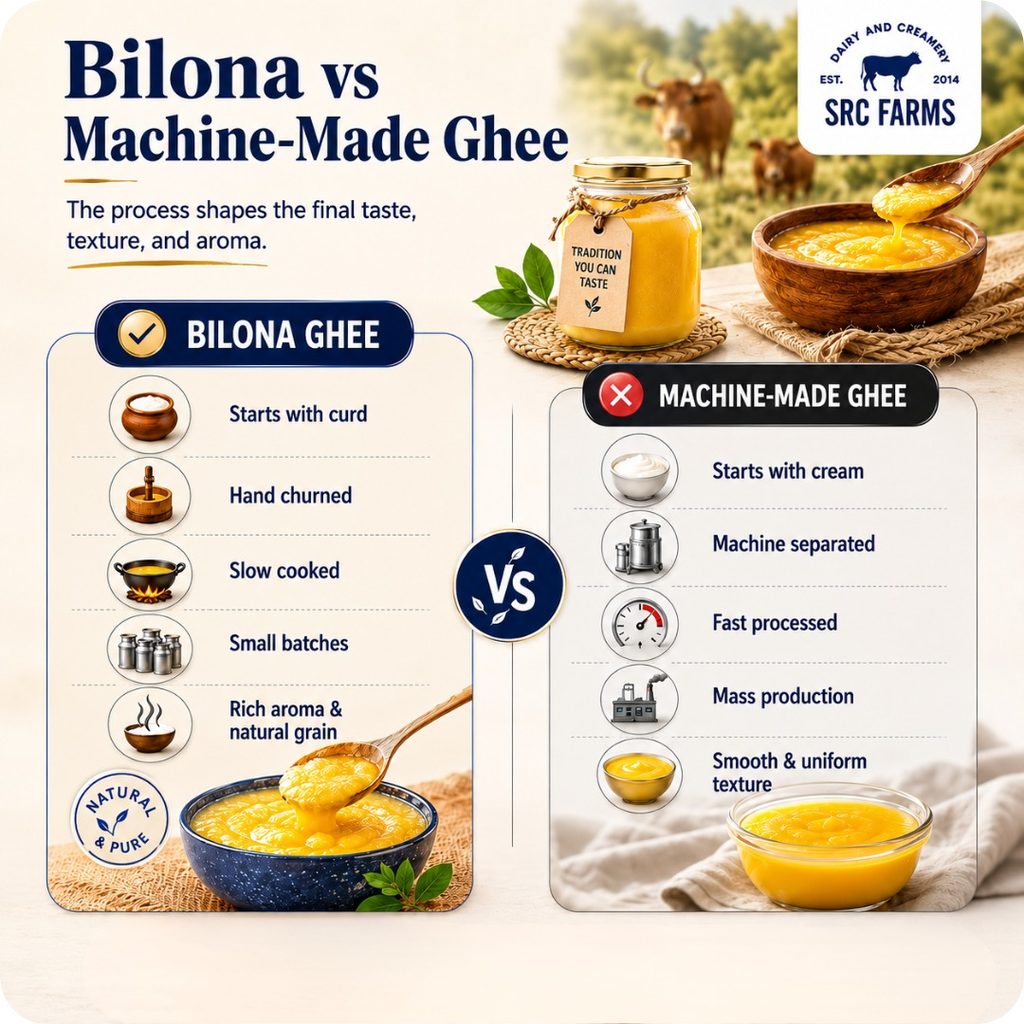
The differences between the two methods come down to a handful of concrete factors, not just marketing language.
Starting point: Bilona ghee starts with curd, hand churned. Machine-made ghee starts with cream, separated using a machine.
Production time: Bilona cow ghee takes 2 to 3 days to make. Machine-made ghee is produced the same day.
Texture: Bilona ghee has a coarser, more granular texture. Machine-made ghee is smooth and uniform.
Colour: Bilona cow ghee has a deeper golden colour. Machine-made ghee tends to be lighter.
Aroma: Bilona ghee has a strong, distinct aroma. Machine-made ghee is comparatively mild.
Batch consistency: Bilona desi ghee has slight natural variation batch to batch. Machine-made ghee stays highly consistent.
Scale of production: Bilona cow ghee is made in small batches. Machine-made ghee is mass produced.
None of this makes machine-made ghee a lesser product on its own, it is simply optimised for speed and consistency. Bilona cow ghee is optimised for the opposite: a slower process that keeps more of the texture and character the traditional method was built to produce.
What Sets SRC Farms A2 Bilona Ghee Apart
SRC Farms’ A2 Bilona Ghee follows the traditional process from start to finish, with no shortcuts taken along the way. The milk comes from indigenous cow breeds, set into curd, hand churned in small batches, and slow cooked on a low flame rather than rushed through mechanical separation to save time.
Batch sizes stay small on purpose, since hand churning does not scale the way machine separation does, and that tradeoff is what keeps the texture, grain, and aroma consistent with how A2 Bilona ghee has always been made.
Conclusion
Bilona ghee and machine made ghee both start as milk, but the road each one takes to reach the jar is completely different. The Bilona process trades speed for texture, aroma, and a grain you can actually see and feel, and when it starts with A2 milk from indigenous cow breeds, that traditional method carries through into every spoonful. SRC Farms sticks to that full process rather than shortcutting it, which is really the whole difference this post has been about. If you have been cooking with regular ghee and want to taste that difference for yourself, the texture and aroma alone usually make it obvious within the first spoonful. Get in touch with SRC Farms to place an order today.
Frequently Asked Questions
Is Bilona ghee better than regular ghee?
It depends what you value. Bilona ghee generally has a stronger aroma, coarser grain, and deeper colour because of the slow, traditional process. Regular ghee is faster to produce and more consistent batch to batch, but it skips the fermentation and hand churning steps that give bilona ghee its character.
What does A2 Bilona ghee taste like?
It tends to have a richer, nuttier flavour with a more noticeable aroma than machine made ghee. The texture is usually more granular rather than smooth.
How long does Bilona ghee last?
Properly made ghee has a long shelf life, often 9 to 12 months at room temperature when stored in a clean, airtight container away from direct sunlight and moisture.
Is A2 ghee good for daily cooking?
Yes, ghee has a high smoke point, which makes it suitable for regular Indian cooking methods like tempering, sautéing, and deep frying, in addition to using it as a finishing fat.
