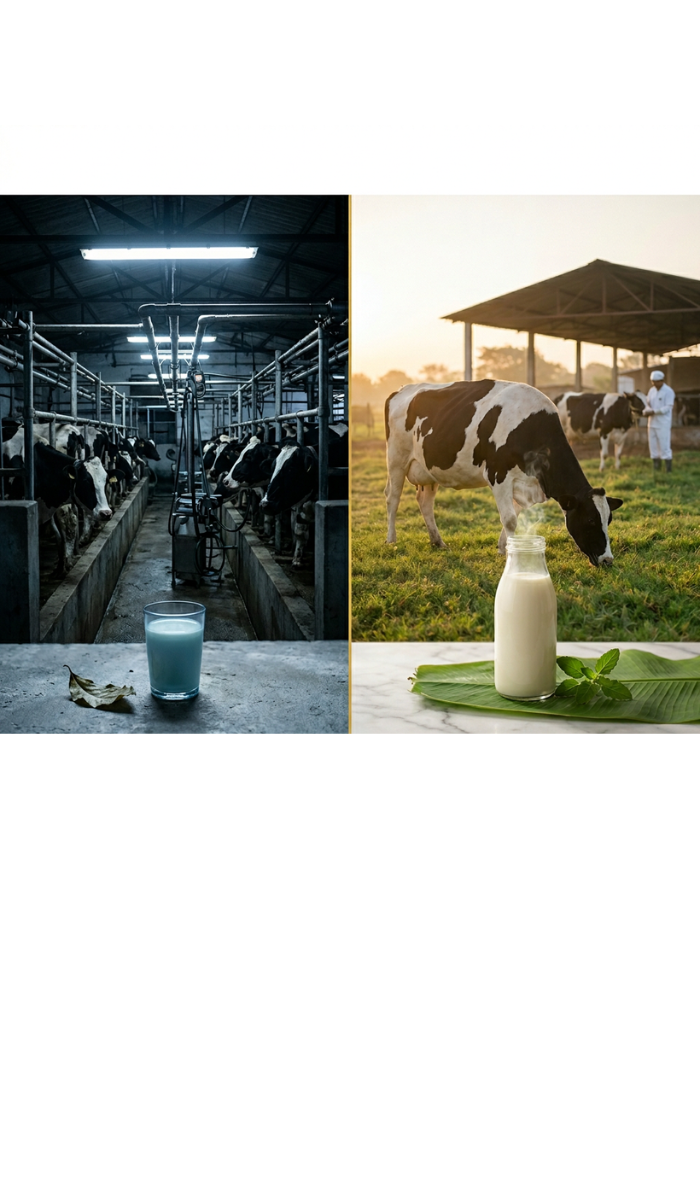
Let’s be honest. Most Indian households don’t think twice about milk. You grab a packet, boil it, pour it into tea, mix it in cereal, and set curd. Done. Milk is treated like a basic commodity.
But milk isn’t basic. It’s daily consumption. Kids drink it. Parents use it. It goes into coffee, paneer, sweets, everything. When something enters your home every single day, how it’s produced starts to matter.
Here’s what most people overlook. Not all milk in India is produced the same way. Farm practices differ. Hormone use differs. Processing methods differ. Shelf life differs.
That’s where hormone-free milk becomes relevant. It’s not a trend. It’s about production decisions at the farm level.
In this blog, we’ll break down what actually happens in commercial dairy, why hormone exposure matters long term, what hormone-free milk really means, and how to choose better milk for your family in India.
Because when it comes to everyday basics, guessing isn’t smart.

What’s Really Happening in Commercial Dairy
Let’s talk about the part nobody reads on the packet.
Milk demand in India is massive. Over 200 million tonnes annually. That pressure doesn’t disappear at the farm level. When production targets go up, shortcuts follow in parts of the supply chain. Not everywhere. But enough to matter.
One of the biggest concerns has been hormone misuse, especially oxytocin in unregulated setups. The goal is simple. Increase milk yield. Faster output. More volume. The problem is long-term exposure. Milk is not something you consume once a month. It’s daily.
This is where hormone-free milk makes a real difference. It means the farm isn’t artificially pushing production through hormone injections. It respects natural lactation cycles.
Then there’s shelf life. Many large-scale systems focus on extending storage. That’s where heavy processing and stabilisation come in. True preservative-free milk doesn’t aim to survive weeks in a warehouse. It aims to reach your home fresh.
And that’s the difference. Volume-driven milk versus source-driven milk.
What Hormone-Free Milk Actually Means
Now let’s clear something up. Every second brand throws around clean-sounding labels. Organic. Farm fresh. Natural. Most of it is noise.
So what does hormone-free milk actually mean in practical terms?
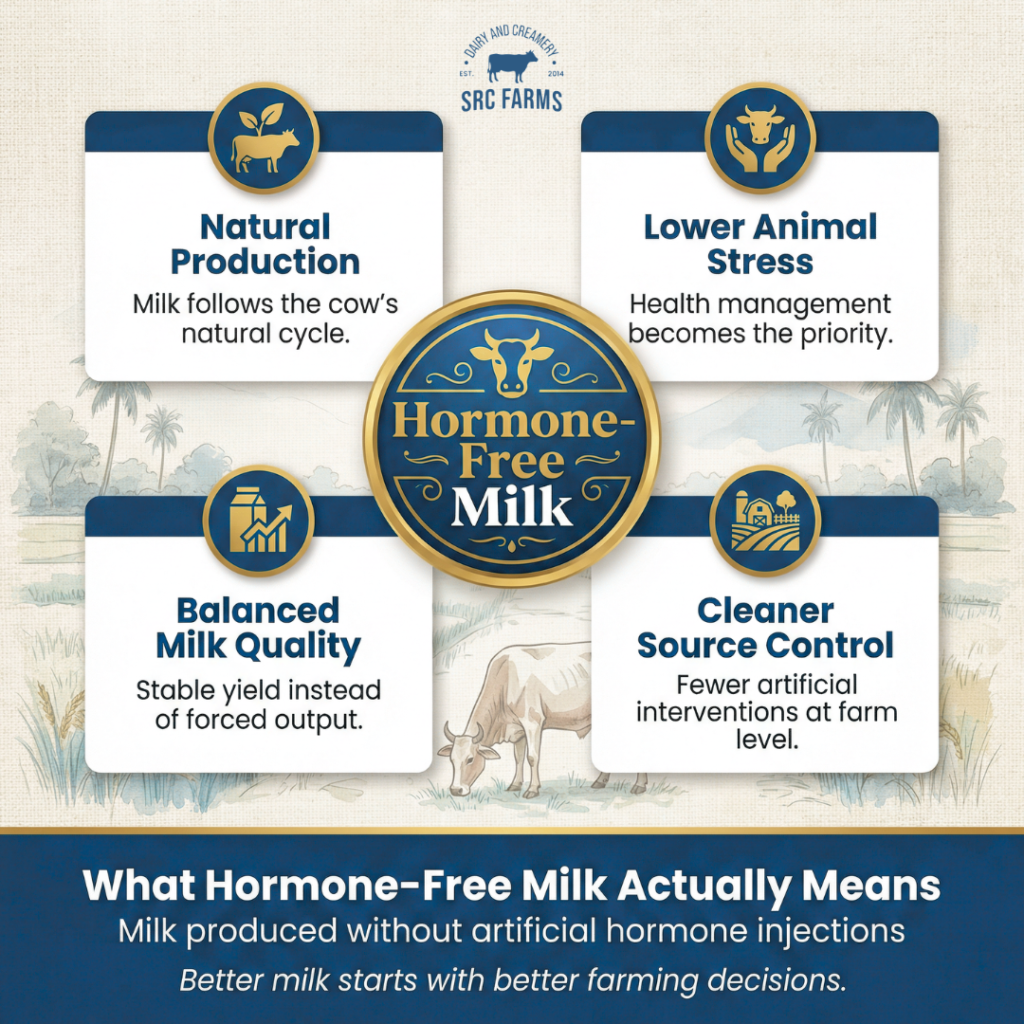
It means cows are not injected with artificial hormones to force higher yield. Milk production follows the animal’s natural cycle. No pushing. No chemical stimulation.
And here’s something most people don’t realise. When you don’t artificially push output:
- The cow isn’t under constant stress
- Milk yield is stable, not extreme
- Animal health management becomes the priority
Healthier animals produce more balanced milk. That’s not marketing. That’s basic biology.
Does hormone-free milk cost more? Yes. Because slower production means lower volume. Ethical farming isn’t the cheapest route.
But the alternative is volume-driven dairy where output matters more than process. If you care about what your family drinks every day, process matters. This isn’t about premium branding. It’s about production discipline.
Why Preservative-Free Milk Matters More Than You Think
People focus heavily on hormones. Fair enough. But they forget to question shelf life.
Milk is naturally perishable. It should spoil. That’s not a defect. That’s how real dairy behaves. When milk comfortably sits for long periods without change, you should pause and ask why.
Large-scale systems often prioritise storage and distribution efficiency. That means higher heat processing or extended handling cycles. The goal is stability. The trade-off is freshness.
That’s why preservative-free milk matters. It signals minimal chemical interference and a tighter supply chain. Proper pasteurisation. Clean storage. Fast delivery. Nothing extra added just to stretch days.
And when that milk also happens to be hormone-free milk, you’re controlling two major variables at once.
Here’s a simple test. Better milk sets firmer curd. It forms richer malai. It tastes cleaner in tea. That’s not imagination. Freshness and processing discipline show up in everyday kitchen results.
Milk is consumed daily. Small differences, repeated daily, add up.
Benefits You’ll Actually Notice at Home
Let’s move away from theory. What changes when you switch to better milk? Real things. Things you’ll notice in your own kitchen.
First, taste. Cleaner. Slightly richer. Not flat.
Second, curd setting. Good milk sets firm dahi. It doesn’t turn watery. If your curd keeps failing, the milk is often the problem, not your method.
Third, malai. Natural cream formation tells you a lot about quality.
Fourth, digestion. Some families report less bloating when they shift to cleaner sourcing. Not magic. Just fewer variables.
And here’s the bigger picture. When you choose hormone-free milk, you’re reducing artificial interference at the source. That stability shows up in consistency. Kids complain less about the taste. Tea looks better. Paneer yields improve.
This isn’t about chasing trends. It’s about noticing performance.
Milk isn’t just something you drink. It’s something you use every day. When the basics improve, the entire kitchen runs better.
Rookie Mistakes Indian Buyers Keep Making
Let’s be blunt. Most people don’t choose milk. They default to it. Here are the common mistakes they make over and over.
1. Choosing the cheapest option.
Saving ₹5 per litre feels smart. Until you realise this is something your family consumes every single day.
2. Assuming “organic” means safe.
Organic feed does not automatically mean no hormone usage. They are different things. Read beyond the front label.
3. Not asking about farm practices.
If a brand can’t clearly explain how their cows are treated or how milk is handled, that’s a red flag.
4. Ignoring testing transparency.
Clean dairy businesses should be comfortable sharing lab reports and quality checks.When people talk about hormone-free milk, they often treat it like a marketing term. It’s not. It’s a production choice. If you don’t question your milk, you’re just trusting packaging. And packaging has never guaranteed quality.

Is It More Expensive? It’s Priced for the Process.
Cleaner dairy production works differently. Smaller volumes. Better farm care. Stricter handling. That naturally reflects in pricing.
Compared to mass-produced milk, you may notice a moderate difference per litre. Over a month, it’s an increase, but usually a manageable one for most urban families.
When you choose hormone-free milk, you’re paying for production discipline, not marketing.
It’s less about comparing price tags and more about understanding what goes into the process behind your daily milk.
Choosing the Right Milk for Your Family
If you’re going to switch, don’t do it blindly. Ask better questions.
Start with the basics:
- Are hormones used to increase milk yield?
- How is the milk tested before delivery?
- What does the cold chain look like from farm to home?
- How quickly does it reach you after milking?
- Can the farm clearly explain its practices?
Transparency matters. If answers are vague, that’s your signal.
Real hormone-free milk producers don’t hide behind labels. They talk clearly about sourcing, testing, and animal care.
That’s where farms like SRC Farms stand apart; they focus on disciplined farm practices, transparent quality checks, and responsible handling from source to doorstep.
This is what you should expect from any serious dairy operation.
Final Straight Talk
Milk is not a once-a-week purchase. It is daily intake..
When something enters your home every single day, small differences matter. Production methods matter. Handling matters. Discipline matters.
Choosing hormone-free milk isn’t about chasing a trend. It’s about reducing unnecessary variables in something your family consumes consistently. The same goes for cleaner sourcing and proper processing.
You don’t need complicated health theories. You need clarity. Know where your milk comes from. Know how it’s produced. Know what’s not added. Families that pay attention to the basics usually make better long-term decisions.
If you genuinely care about what your family consumes every day, don’t rely on labels alone. Choose a dairy farm that is open about how its milk is produced, tested, and delivered. The right farm won’t hesitate to share the details.
